
Why Does a CAT 320C / 320D Hydraulic Pump Lose Power Under Heavy Load?


Autor
Abby
Guangzhou Rito Engineering Machinery Equipment Co., Ltd., ubicada en Guangzhou, China, es un fabricante y distribuidor líder de bombas hidráulicas, transmisiones finales, motores de giro y válvulas de control principales para maquinaria de movimiento de tierras. Suministramos repuestos originales, OEM y de alta calidad para el mercado de repuestos.
Nos comprometemos a compartir continuamente nuestra experiencia en maquinaria de construcción y sistemas hidráulicos para excavadoras. Nuestro objetivo es ayudarle a comprender mejor los principios y aplicaciones de los equipos, permitiéndole trabajar con mayor eficiencia, a la vez que demostramos nuestro conocimiento y capacidades profesionales. Le invitamos a conocer más sobre nosotros.
¡Elíjanos y disfrutará del mejor servicio, los precios más favorables y el proveedor más confiable!
Marie R. Winters


Quick Answer
Key Takeaways
- Leakage is proportional to pressure, which is precisely why the fault shows up under load and not at idle.
- The pump compensates for wear until it cannot — so the machine feels normal for a long time, then suddenly does not.
- Worn rotating group, a tired load-sensing control, suction problems, relief settings and oil condition are the usual causes, in that order of suspicion.
- Weakness in every function points at the pump and its control; weakness in one function does not.
- Check whether the engine is losing rpm rather than the hydraulics losing flow — the two produce a similar complaint.
- The pump is ordered by the plate, not the model name — and this assembly carries a long list of numbers, including ones Cat has superseded.
Table of Contents
- 1. Why the Weakness Appears Only Under Load
- 2. The Causes, in the Order to Check Them
- 3. Two Cheap Tests That Settle Most Cases
- 4. The Symptoms That Rule the Pump Out
- 5. What Heavy-Duty Wear Does Inside
- 6. Which Number Fits Your Machine
- 7. FAQ
- 8. Confirm Before You Order
- 9. Get Your Pump Confirmed
1. Why the Weakness Appears Only Under Load
To understand this fault you only need one idea: every internal clearance in a piston pump leaks more as pressure rises. The pistons, bores and valve plate are not perfectly sealed — they cannot be, because they must slide. At low pressure the leakage is trivial. At working pressure, it is not.
That produces a very specific behaviour pattern, and it explains why owners are so often told "the pump is fine" by someone who only watched it run at idle:
| Condition | What the pump does | What you feel |
|---|---|---|
| Light load, flat ground | Low pressure, minimal internal leakage; the pump meets demand comfortably | Nothing unusual — the machine feels normal |
| Moderate load | Leakage begins to rise; the pump strokes further to compensate | Slightly slower cycles, oil warming a little more than it used to |
| Heavy load in the pile | Pressure peaks, leakage peaks with it, and the pump runs out of stroke to compensate | Power falls away. The machine stalls in the cut, then recovers when the load eases |
Read the middle row again, because it is why this fault is so often discovered late. A worn pump hides its own wear by working harder. It strokes further, the engine works harder, the oil runs hotter — and the operator notices none of it until the day the pump can no longer compensate at all. The mechanism behind it is set out in our explainer on how a variable-displacement piston pump works.
So the honest answer to "why does it lose power under heavy load" is: because heavy load is the only condition under which the wear is big enough to feel. Everything before that was the pump covering for itself.
2. The Causes, in the Order to Check Them
Seven things produce this symptom, and they are not equally likely. Work down the list rather than starting at the most expensive one.
| # | Cause | How it behaves | How to confirm |
|---|---|---|---|
| 1 | Worn rotating group (plungers, bores, valve plate) | Weak under load, heat rises, all functions affected | Pressure drops when loaded, plus high case drain flow |
| 2 | Load-sensing control tired or mis-set | The pump does not stroke up enough as load rises; response feels lazy rather than dead | Control pressure test against specification |
| 3 | Suction restriction or low oil | Worse when hot; whining or cavitation noise; flow falls when demand peaks | Inspect suction strainer, lines and tank level |
| 4 | Main relief set low or leaking | The whole system tops out below specification, so power is capped | Relief pressure test at the valve |
| 5 | Control signal problem (where the machine uses electronic pump control) | Behaves like a hydraulic fault; can be intermittent or mode-dependent | Check the signal and solenoid before condemning the pump |
| 6 | Oil condition and temperature | Thin, hot or contaminated oil leaks faster and lubricates worse | Sample the oil; check temperature under load |
| 7 | Valve-side leakage | Pressure generated by the pump is lost at the valve, not inside it | Functions test: selective weakness points here, not at the pump |
Cause 1 is the one this article is about, and it is also the one that gets diagnosed by hope most often — "it still builds pressure, so the pump must be fine". It builds pressure at no flow, which is exactly what a worn pump can still do. The test that catches it is the next section.
3. Two Cheap Tests That Settle Most Cases
You do not need to remove anything to reach a confident answer. Two measurements do most of the work.
| Test | What it tells you |
|---|---|
| Pressure and flow, under load | A pump that reaches pressure but cannot hold flow when loaded is leaking internally. This is the single most direct confirmation of pump wear — and it must be done under load, not at idle |
| Case drain flow | Measures the leakage directly. A reading that has climbed against your own baseline, taken at the same oil temperature and operating point, is the earliest reliable warning you can get — see how to read case drain flow |
Both tests share one rule: record the conditions — oil temperature, engine speed, and which function was loaded. A flow figure without its conditions proves nothing, and it cannot be compared with the next reading.
Together they separate the three realistic outcomes: a pump that is worn (replace or rebuild), a pump that is fine but badly set or supplied (a much smaller job), and a fault that is not in the pump at all.
4. The Symptoms That Rule the Pump Out
Two findings reliably point away from the pump, and both save money.
First: weakness in only one function. The pump feeds every function from one source, so it cannot fail in a way that spares all but one of them. If the boom is weak and the arm, bucket, swing and travel are normal, the fault is in that function's valve section or cylinder — not the pump. This single distinction prevents more unnecessary pump purchases than any other diagnostic step, and it is the same logic we applied to the SBS140 pump on the 329D.
Second: the engine is the thing losing power. This is worth stating plainly, because "loses power under load" is a phrase that hides two different problems. If the engine drops rpm, stifles or smokes when the bucket loads up, you may be looking at a fuel, air or engine-management fault — not a hydraulic one. The machine feels weak in both cases; only the engine's own behaviour tells them apart. Watch the tachometer under load before you spend anything on hydraulic parts.
5. What Heavy-Duty Wear Does Inside
Inside the pump, the parts that decide whether it still makes pressure are the ones that slide and seal: the plungers running in their bores, and the valve plate that controls the porting at the end of the barrel.
Two things happen to them under sustained heavy-duty work — mining conditions, rock, continuous high pressure:
- Surfaces scuff and wear, opening the clearances that were sized to seal. Leakage rises, and with it the heat.
- Contamination accelerates the process. Particles that get past the filtration lap the sliding surfaces and score the plate; the wear then becomes self-accelerating.
That is why strengthened plunger and valve-plate material matters commercially rather than theoretically. Holding internal leakage under control is holding the machine's power, all the way until the pump is genuinely worn out — and it is the characteristic the 320C / 320D pump shares with the rest of its family. The same design logic scales across the SBS range: the SBS80 on the smaller 312C and the SBS180 on the 336F differ in size, not in principle.
One generation note that matters when you are sourcing: the 320B that came before used a bent-axis pump, and the 320C moved to this swash-plate SBS120 design. The two are not interchangeable, and the change is one more reason the model name alone never identifies the pump — the 320B arrangement is set out in our guide to the 320B A8VO107 and bent-axis versus swash-plate.
6. Which Number Fits Your Machine
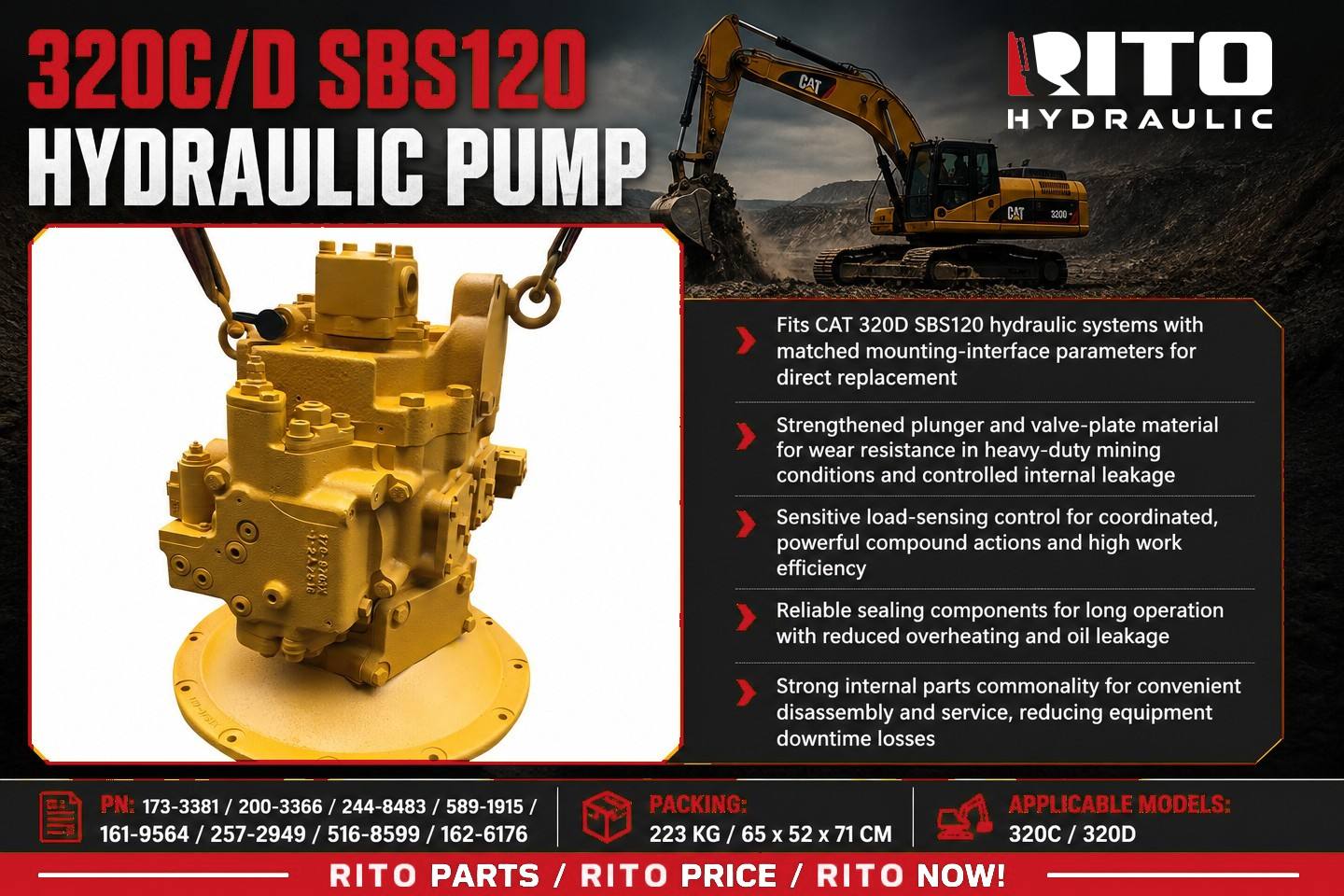
If the tests confirm pump wear, this is the identification you need. The main pump for the 320C / 320D is quoted under a long list of numbers:
| Number quoted |
|---|
| 173-3381 |
| 200-3366 |
| 244-8483 |
| 589-1915 |
| 161-9564 |
| 257-2949 |
| 516-8599 |
| 162-6176 |
| Item | Detail |
|---|---|
| Pump type | SBS120 swash-plate main pump, load-sensing control |
| Applications | CAT 320C / 320D (320C variants commonly listed with the 3066 engine) |
| Packing | 223 kg, 65 x 52 x 71 cm |
Why there are so many numbers — and it is a real reason, not a mystery. Caterpillar revises pump part numbers over a machine's production life, and the original number for this assembly, 173-3381, is listed by Caterpillar's own parts catalogue as no longer available, directing you to a replacement option. When the maker supersedes a number, the old one keeps circulating in the market alongside the new. That is how one pump ends up quoted eight ways.
Two cautions follow, and both matter on a 223 kg part:
- Do not assume a listed number is a supersession for your machine. Some are genuine replacements, some are alternative or neighbouring references. The plate on your old pump, read together with the machine serial, is what confirms it.
- Numbers are written in several forms. You will see the same reference with and without the dash (173-3381 / 1733381) and sometimes with a CA prefix. That is catalogue variation, not a different part — match the number as a whole.
Replacement pumps and the wider spare range are grouped under excavator hydraulic parts.
7. FAQ
Q1: Why does my 320C or 320D only lose power under heavy load?
Because internal leakage rises with pressure. At light load the clearance leakage is negligible and the pump meets demand easily; at full working pressure the leakage is large enough to steal flow from the actuators. That is why the machine feels fine on the flat and weak in the pile.
Q2: The machine felt normal until recently. How did the pump wear out so fast?
It probably did not. A worn pump compensates by stroking further, which hides the wear until it runs out of stroke. Oil temperature creeping up and slightly slower cycles were the early signs; the sudden weakness is the point at which compensation stopped being enough.
Q3: What tests confirm the pump is the problem?
A pressure and flow test under load, and a case drain flow reading at operating temperature. A pump that reaches pressure but cannot hold flow when loaded, with high case drain flow, is leaking internally. Record the conditions with every reading.
Q4: What if only one function is weak?
Then the pump is unlikely to be the cause. The pump feeds every function from one source and cannot fail selectively. One weak function points at that valve section or its cylinder — check there first.
Q5: The engine sounds like it is stifling when I dig. Is that the pump?
Not necessarily — that behaviour can indicate an engine-side fault (fuel, air or engine management) rather than hydraulics. Watch the tachometer under load: if engine rpm is falling, investigate the engine before buying hydraulic parts.
Q6: What is the part number for the 320C / 320D main pump?
It is quoted under 173-3381, 200-3366, 244-8483, 589-1915, 161-9564, 257-2949, 516-8599 and 162-6176. Note that Caterpillar lists 173-3381 as no longer available and directs users to a replacement option, which is why several numbers circulate.
Q7: Is the 320C pump the same as the 320B pump?
No. The 320B used a bent-axis pump; the 320C moved to this swash-plate SBS120 design. They are different assemblies and not interchangeable, which is a good reminder that the model name alone never identifies the pump.
Q8: Can the pump be repaired instead of replaced?
Often yes — the internals of this family are available, so a rebuild is viable when the damage is confined and the unit is properly re-tested. If wear spans the rotating group and the control, a complete tested assembly is usually the safer spend.
Q9: Will a new pump fix the problem on its own?
Only if the pump was the only problem. A new pump fitted into a contaminated system, or with the relief mis-set or suction restricted, will fail again or still feel weak. Flush the circuit, check the suction side and confirm the settings as part of the job.
Q10: What should I send to get a quotation?
The machine model and serial number, the plate code from the old pump, your pressure, flow or case drain readings with the conditions they were taken under, and two or three clear photographs of the pump including the plate, flange and ports.
8. Confirm Before You Order
Six items turn this from a guess into a single round of supply:
- 1. Machine model and serial number — the serial identifies the build, not the badge.
- 2. The full plate code from the old pump — read it and photograph it; never transcribe from memory.
- 3. Your test readings — pressure under load, flow, and case drain flow, each with oil temperature and engine speed.
- 4. Which functions are affected and when — all of them or one; hot or cold; light load or heavy.
- 5. Photographs of the pump — plate straight-on and in focus, plus flange and port faces.
- 6. Oil condition — a sample or a photograph of it. Metal or milkiness changes the recommendation entirely.
9. Get Your Pump Confirmed
Send us your machine model, serial number, plate code and test readings — plus a few clear photos — and our team will help you read them, confirm the correct assembly for your 320C or 320D, tell you whether a repair or a replacement is the sensible route, and quote lead time the same day. RITO HYDRAULIC supplies complete, individually tested main pumps, control valves, swing devices and travel motors for Caterpillar, Komatsu, Hitachi, Kobelco, Hyundai, Doosan, Kawasaki and SANY machines — with export packing and a 6–12 month warranty.
Contact our team or learn more about RITO HYDRAULIC.
- ¿Cuándo debería reemplazar la caja de engranajes del mando final de una Caterpillar 320 GX?
- ¿Cómo funciona la válvula de control principal en una SANY SY205 o SY215?
- ¿Por qué una SANY SY500 se desplaza lentamente por un lado? Guía de diagnóstico del mando final
- Desgaste de la bomba hidráulica PC600-6: cómo el flujo de drenaje de la carcasa revela daños internos
- ¿Por qué la Kawasaki K3V112DT es tan común en excavadoras de 20 toneladas?